
What are the parts of the EN 14181 standard?
EN 14181 is a European standard, adopted in Sweden by SIS as SS-EN 14181, that describes how an automated measuring system (AMS) for emissions is quality-assured from installation and throughout operation. The Swedish Environmental Protection Agency summarises the standard in four parts: requirements on the measuring instrument (QAL1), calibration (QAL2), ongoing checks during operation (QAL3) and the annual surveillance test (AST).
QAL2 and AST are therefore single occasions, a year or more apart. QAL3 is what shows that the AMS keeps its quality in between.
Where are the QAL3 requirements set?
The standard becomes binding through Swedish ordinances that require emissions monitoring to follow CEN standardsEuropean standards (EN) developed by CEN, the European Committee for Standardization. In Sweden they are adopted as Swedish standards with the designation SS-EN, such as SS-EN 14181..
The ordinance (2013:252) on large combustion plants (förordningen om stora förbränningsanläggningar) requires continuous measurement of sulphur dioxide, nitrogen oxides and dust at 100 MW or more, with certain exemptions. Quality assurance of automated measuring systems, and the reference measurements used to calibrate them, must follow CEN standards. The systems must be checked at least once a year by parallel measurements with reference methods, and the results reported to the supervisory authority.
The ordinance (2013:253) on waste incineration (förordningen om förbränning av avfall) has the same structure: CEN standards for quality assurance and calibration, and an annual check of installation and function by parallel measurements.
The industrial emissions ordinance (2013:250) has no provision of its own on measuring systems. Requirements then come through BAT conclusionsBAT stands for best available techniques. BAT conclusions are European Commission decisions on best available techniques in different sectors, and they can include associated emission levels (BAT-AELs). In Sweden those emission levels apply as emission limit values under the industrial emissions ordinance (2013:250), in addition to the permit, and must be met no later than four years after the conclusions are published. The techniques described are not mandatory if an equivalent level of protection is achieved in another way. and the permit.
Plants that pay the NOx charge have a separate set of rules, NFS 2016:13, which applies alongside the Environmental Code. It requires ongoing checks at least once per calendar month, with its own limits. QAL3 under EN 14181 may be used to meet that requirement, but the limits in the regulation still apply.
The Swedish Environmental Protection Agency points out that what the standard states as “shall” must be followed, while “may” and “should” are not requirements under the ordinances.
What is QAL3?
The core of QAL3 is recurring zero and span checks. The analyser measures zero gas and reference gas of known concentration, and the result is compared with the expected value. What is followed over time is whether the zero point and span value drift, and whether they stay stable from one check to the next. The yardstick is the performance established at QAL1. An AMS can therefore show plausible values in the control room and still have drifted further than it is allowed to.
The results are recorded at every check and compared with the previous ones, usually in a control chart with a set limit for how large the deviation may be. It is the comparison over time that makes a gradual drift visible before it becomes a problem.
How often the checks must be made is governed by the standard and by the regulations that apply to the site. For plants that pay the NOx charge the minimum is once per calendar month. Some analysers can run the zero and span check automatically.
Who is responsible for what?
Whoever operates the plant must continuously plan and control it. That responsibility cannot be handed over to a laboratory or a service provider, although the work can be done by someone else. Every operation must also have a documented allocation of organisational responsibility, and routines for checking that equipment for operation and control is kept in good condition.
Responsible for QAL3 and for ensuring that QAL2 and AST are carried out. Performs some parts of the AST. Ensures the records exist and can be shown at a regulatory inspection.
Carries out QAL2 and most of the AST. Accredited for the measurements in question.
Provides the certification (QAL1) and sells instruments and spare parts that work as intended. Installation and commissioning are usually done by a distributor, under contract.
Can carry out service and maintenance, zero and span checks, adjustments and documentation on the operator’s behalf.
The checks are made, but nobody has been given the task of following the results and deciding what to do when something deviates. That is exactly why the requirement for a documented allocation of responsibility exists.
What happens when a check deviates?
When a check shows that the limit has been passed, the cause must be investigated and the AMS adjusted or repaired. What was done, when and by whom is documented.
If QAL3 shows that the AMS no longer holds its quality, a new QAL2 may be necessary. The standard sets out the conditions under which QAL2 must be carried out more often than every five years.
For plants that pay the NOx charge the rules are stricter. There the span point is called the reference point. The measuring equipment must be adjusted no later than when the zero or reference-point deviation exceeds 4.0 per cent of the reference-point concentration, except for deviations below 2.0 ppm for nitrogen oxides. The adjustment must be documented. If the limit is exceeded, the measured values from the period after the last approved check are not valid. The Swedish Environmental Protection Agency therefore recommends adjusting in time, before the limit is passed, and running a new check immediately after the adjustment. If adjustment is needed often, it may be a sign that the instrument is not good enough.
Why is the fault not always in the analyser?
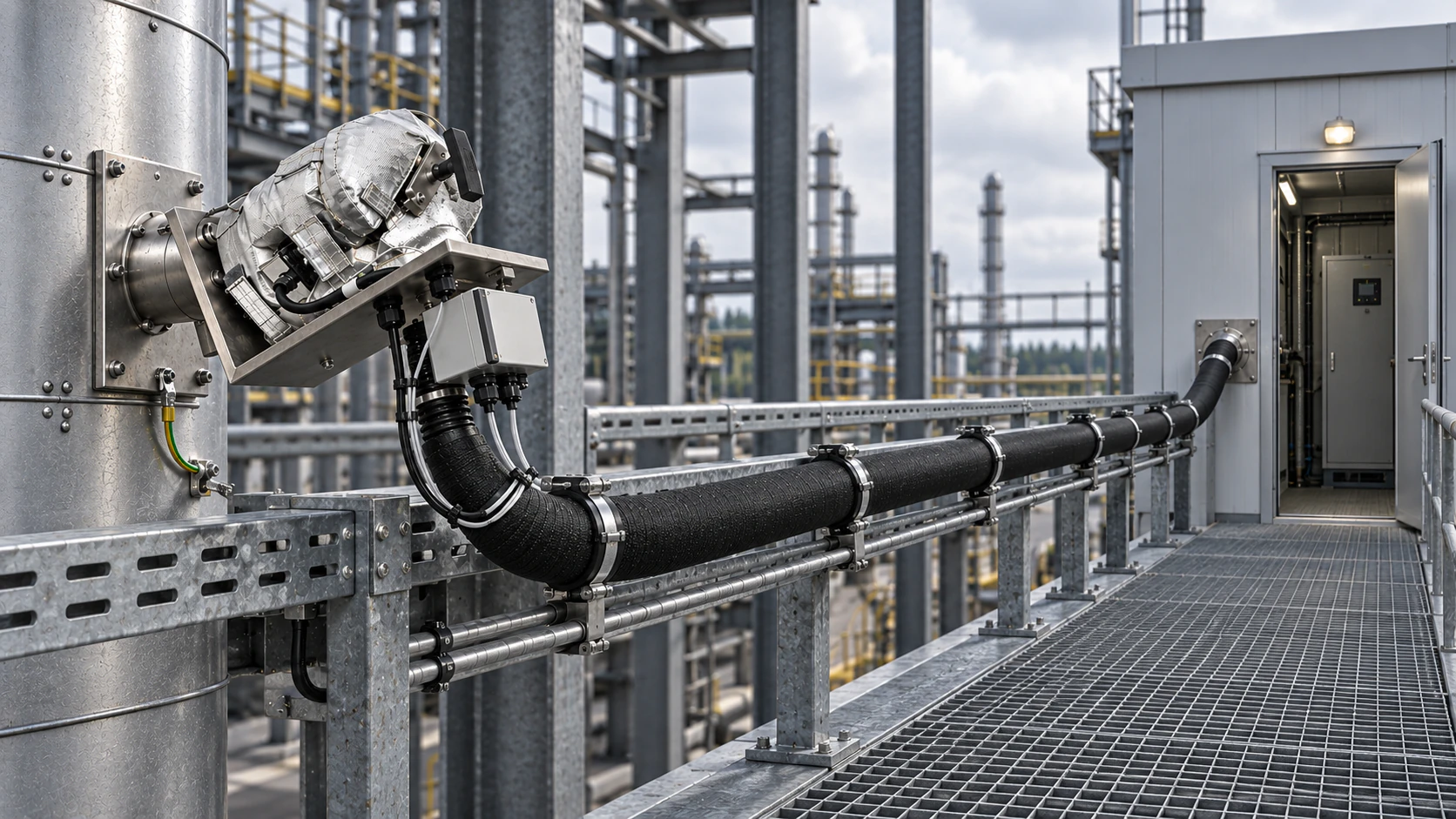
A deviation in the check shows that something has changed, but not where. The drift may originate earlier in the measuring chain: a leak letting in air ingress, condensation at a cold spot in the sample line, or a sample gas cooler or a filter in the sample conditioning that is not working as it should.
Where the reference gas is injected determines which parts of the measuring chain the check covers. Injected at the analyser, the result depends on the analyser alone. Injected at the probe, it also passes through the sample line and the sample conditioning.
That is why an investigation starts with the entire measuring chain and not just the analyser.
Read about the measuring chain stage by stage →What records are needed before the AST and inspections?
The operator must document which requirements apply, which methods are used, the technical characteristics of the measuring equipment, the conditions at the measurement, time and place, and the results. The documentation must be kept for five years. The permit may require longer.
For QAL3 this means in practice: the results of every zero and span check with the values actually read, not just “OK”, adjustments with dates, service and maintenance notes, and the results from QAL2 and AST.
Consolidated records make it easier to prepare for the annual surveillance test and to answer when the supervisory authority asks.
How the technical history is built up →How can ARKTEC help with QAL3?
This article is based on EN 14181:2014, Stationary source emissions – Quality assurance of automated measuring systems, and on the Swedish Environmental Protection Agency’s guidance on large combustion plants, waste incineration and measuring equipment for the NOx charge. The requirements are set out in, among others, the ordinances (2013:252) on large combustion plants and (2013:253) on waste incineration, NFS 2016:13 and NFS 2021:6.
- EN 14181:2014 (SIS, Swedish Institute for Standards) (opens in a new tab)
- Ordinance (2013:252) on large combustion plants (Swedish) (opens in a new tab)
- Ordinance (2013:253) on waste incineration (Swedish) (opens in a new tab)
- Industrial Emissions Ordinance (2013:250) (Swedish) (opens in a new tab)
- NFS 2016:13 (Swedish EPA) (opens in a new tab)
- NFS 2021:6 (Swedish EPA) (opens in a new tab)
- Swedish EPA guidance on large combustion plants (Swedish) (opens in a new tab)
- Swedish EPA guidance on waste incineration (Swedish) (opens in a new tab)
- Swedish EPA guidance to NFS 2016:13 for operators (Swedish) (opens in a new tab)
This article concerns gas analysers in extractive measuring systems and is general information. The requirements for your particular site are set out in the regulations, your permit and the standard itself.